
1강Geometry무료 체험
Triangles
- 강좌
- Geometry and Trigonometry
- 문제 유형
- 직선·각·삼각형
- 연습
- 전략 강의
- 언어
- 베트남어 · 영어
이 강의는 선택한 언어 버전이 아직 없어 영어 버전을 보여 줍니다.
Terminology
| Right Triangle | A triangle with one right angle (90 degrees). |
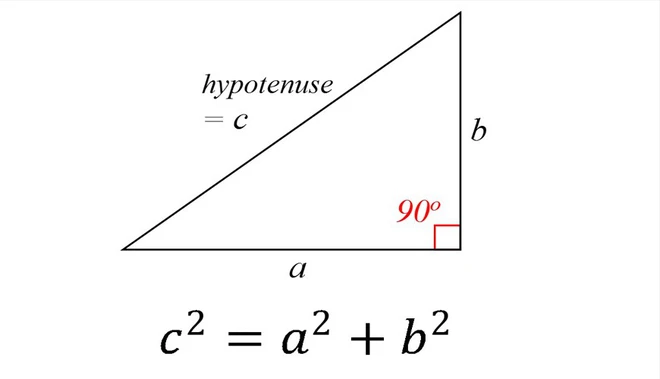
| Hypotenuse | The longest side of a right triangle, opposite the right angle. |
| Leg | Either of the two sides that form the right angle; relative to a given acute angle, they are the opposite leg and the adjacent leg. |
| Trigonometric Ratio | A ratio that relates the angles and the sides of a right triangle. |
| Obtuse angle | An angle measuring more than 90o but less than 180o. |
| Acute angle | An angle measuring less than 90o. |
| Similar triangles | Triangles are similar if their 3 corresponding angles are equal and their 3 corresponding sides are proportional. |
| Congruent triangle | Triangles are congruent if all their corresponding sides and angles are equal. |
| Scale factor | The ratio of the lengths of corresponding sides of similar figures. |
| Isosceles triangle | A triangle with two equal sides. |
| Equilateral triangle | A triangle with three equal sides. |
| Trigonometric Ratio | A ratio that relates the angles and the sides of a right triangle. |
| Angle of elevation | The angle between the line of sight to an object and the horizontal ground in front of the observer. |
Formulas
- The sum of the three angles of a triangle is 180o
Extension: The sum of the interior angles of a polygon = (number of sides - 2) ⨉ 180o

Where: A is the area, b is the base, and h is the height (altitude)
- Equilateral triangle:
 (s: side length)
⇒ A = 
⇒ A = 
- Pythagorean theorem: In a right triangle, the square of the hypotenuse equals the sum of the squares of the two legs.
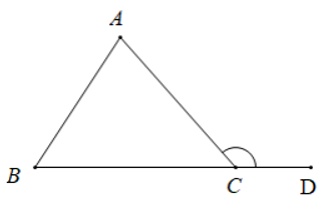
Exterior angle of a triangle
 180O
180O
 180O
180O
⇒ 
The sum of the exterior angles of any polygon is 360o
- Congruent triangles and similar triangles
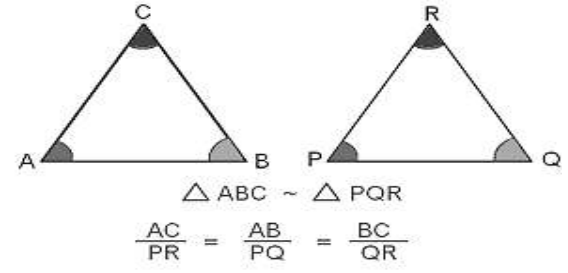
When solving problems about congruent and similar triangles, the most important step is to identify the corresponding vertices
- Trigonometric ratios
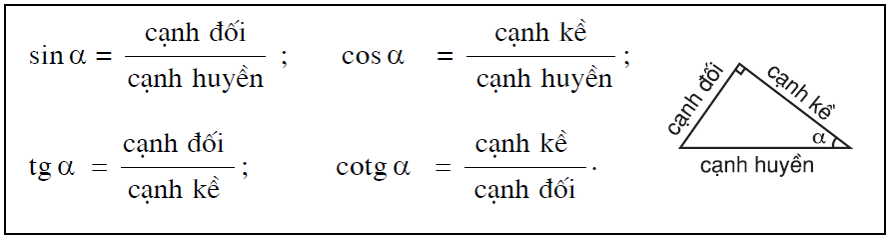
Memory tip: SOH-CAH-TOA — sin = Opposite/Hypotenuse, cos = Adjacent/Hypotenuse, tan = Opposite/Adjacent