Exponents and exponential functions
- 강좌
- Advanced Math
- 문제 유형
- 비선형 함수
- 연습
- 전략 강의
- 언어
- 베트남어 · 영어
이 강의는 선택한 언어 버전이 아직 없어 영어 버전을 보여 줍니다.
2.1. Properties of exponents
Formulas
- an = a ⨉ a ⨉ a ⨉ … (n factors of a)
- a1 = a
- a0 = 1 (a ≠ 0)
- am ⨉ an = am+n


- (am)n = am⨉n
- (a ⨉ b)m = am ⨉ bm



2.2. Exponential functions
Terminology
| exponential function | A function of the form y = abx, where a and b are constants. |
| exponential growth | An exponential function whose factor is greater than 1. |
| exponential decay | An exponential function whose factor is less than 1. |
Formulas
- General form: y = a ⨉ bx (a,b > 0; b ≠ 1)
Where:
a: y-intercept
b: factor
What the constants mean
- The y-intercept a
Substituting x = 0 into the function gives
y = f(0) = a ⨉ b0 = a
x = 0 is the equation of the y-axis ⇒ y = a is where the graph of y = f(x) meets the y-axis ⇒ a is called the y-intercept
- The factor b:
Example: For the function y = f(x) = 3 ⨉ 2x, the table of values is:
| x | y |
| 0 | 3 |
| 1 | 6 |
| 2 | 12 |
| 3 | 24 |
| 4 | 48 |
each time x increases by 1 unit, y doubles (increases by a factor of 2). This is exactly the value of the factor b:
- x goes from 0 → 1, y goes from 3 → 6
- x goes from 1 → 2, y goes from 6 → 12
- x goes from 2 → 3, y goes from 12 → 24
- x goes from 3 → 4, y goes from 24 → 48
In general: Meaning of the factor b:
Consider the exponential function y = f(x) = a ⨉ bx
⇒ f(x + 1) = a ⨉ bx+1 = a ⨉ bx ⨉ b = f(x) ⨉ b
When x increases by 1 unit, y is multiplied by b ⇒ When x increases by n units, y is multiplied by bn
⇒ This is how you recognize an exponential function
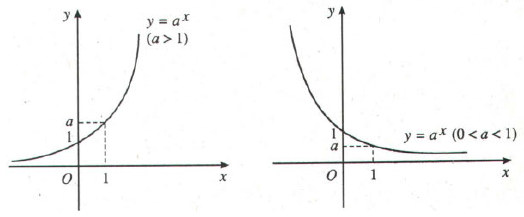
- b > 1 ⇒ f(x) is increasing ⇒ the graph rises from left to right and gets steeper and steeper
- 0 < b < 1 ⇒ f(x) is decreasing ⇒ the graph falls from left to right and gets flatter and flatter
Formula for finding the factor b:

Applications
- Applying the theory to word problems
Problem 1: Tom is saving money to buy a new bicycle. He currently has $50 saved up, and his savings increases by 1% each week. How much money will Tom have saved after 8 weeks?
Let x be the number of weeks that have passed and y be the amount of money Tom has saved
- Each week, Tom's savings increase by 1%
⇒ When x increases by 1 week, y is multiplied by 100% + 1% = 1.01 ⇒ This is the sign of an exponential function
⇒ Factor b = 1.01
- At the start (before any week has passed), Tom already has $50 saved
⇒ When x = 0, y = f(0) = 50 ⇒ y-intercept a = 50
Putting the two facts together ⇒ The exponential function is y = f(x) = 50 ⨉ 1.01x
⇒ After 8 weeks, Tom has saved f(8) = 50 ⨉ 1.018 ≈ $54.14
Problem 2: Randy opened a savings account by making a deposit of $750. The savings account earns 5 percent interest, compounded quarterly. Which of the following expressions should Randy type into his calculator if he wants to know how much money he will have in 10 years, assuming he makes no other deposits?
Compound interest formula:
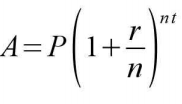
Where:
A: the amount of money at time t
P: the principal (initial amount)
r: the annual interest rate
n: the number of times interest is compounded per year
t: the number of years
P = $750, r = 5%, n = 4 (because interest is added every quarter - compounded quarterly - and 1 year = 4 quarters), t = 10 ⇒ 
- Graphs of exponential functions
| y = a ⨉ bx | b > 1 | 0 < b < 1 |
| Left end of the graph | Approaches the x-axis (y = 0) | Goes to infinity |
| Right end of the graph | Goes to infinity | Approaches the x-axis (y = 0) |